
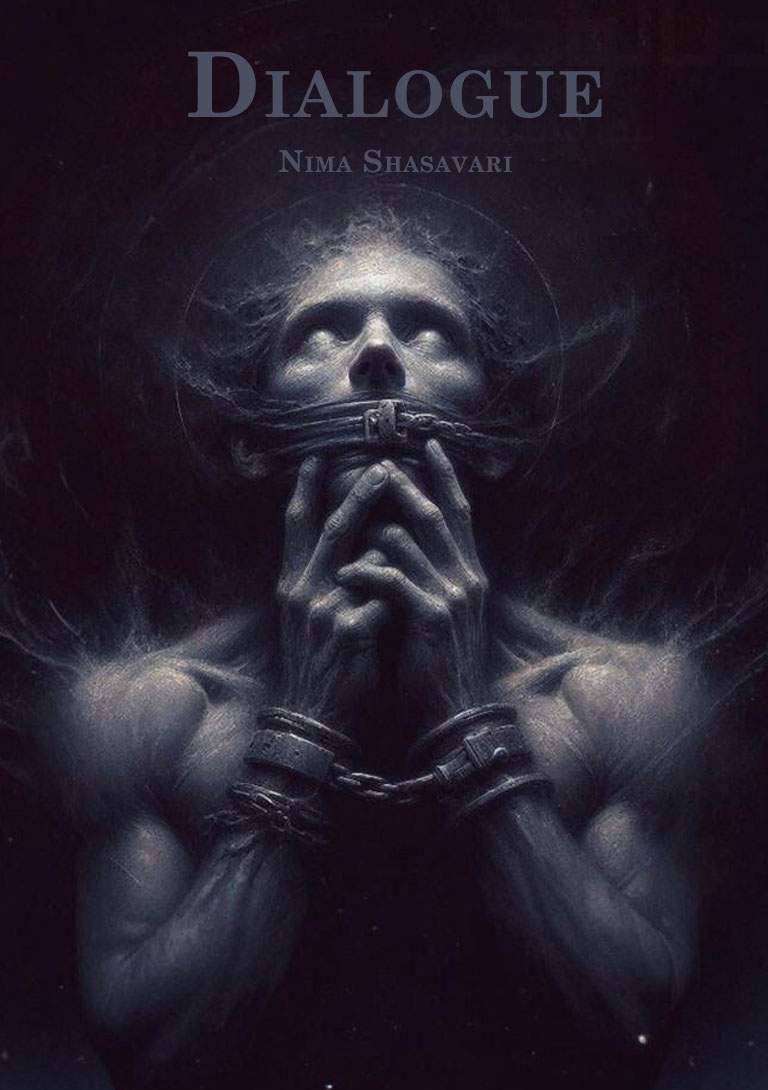


Transitioning from the Religion of Power to the Ethics of Life
In Dialogue, Nima Shahsavari delivers a penetrating philosophical exploration that challenges humanity to move beyond the destructive paradigms of power and domination. Structured as a rigorous debate between opposing worldviews, the text exposes how traditional religious and political systems have institutionalized cruelty under the guise of divine law. For centuries, the theological justification of punishment and hierarchical supremacy has conditioned societies to accept suffering as an inevitable condition. This work systematically dismantles that premise, arguing that true ethical maturity begins with the total rejection of harm.
The narrative deconstructs the anthropocentric illusion of human nobility, showing how speciesism and social stratification serve as ideological tools for exploitation. As long as societies view the non-human world—plants, animals, and ecosystems—as mere resources subject to human convenience, the root of tyranny remains untouched. Liberation requires an ontological expansion of empathy, recognizing that moral consideration must extend across the entire spectrum of sentient existence.
The Dialectic of Awakening and Intellectual Resistance
A central strength of Dialogue lies in its conversational architecture, which mirrors the internal and social tensions between uncritical obedience and radical awakening.
- The Voice of Conditioned Tradition: Representing the uncritical acceptance of historical dogma, social convenience, and inherited submission to authority.
- The Voice of Universal Conscience: Breaking down artificial boundaries of race, religion, and species to demand absolute accountability for suffering.
- The Power of Discourse: Replacing the violence of coercion with the transformative force of critical dialogue and intellectual clarity.
Through this dynamic exchange, the author demonstrates that breaking free from dogmatic slumber requires active engagement, critical inquiry, and the courage to question the foundational myths of civilization.
Deconstructing the Theology of Violence
The text undertakes a fearless critique of violent legal frameworks embedded within historical traditions. It challenges the apologists of religious violence who attempt to soften or rationalize cruel statutes under abstract philosophical defenses. Shahsavari argues that an authentic moral order cannot originate from an authority that mandates punishment, subjugation, or the destruction of life. True divinity, if conceptualized ethically, must be entirely divorced from the mechanics of suffering.
This critique aligns seamlessly with the principles of Janism, positioning the absolute cessation of harm as the foundational law of a civilized universe. Responsibility is shifted entirely from celestial proxies back to human agency; individuals must consciously choose to become guardians of life rather than executioners of nature.
Ethical Dissemination and the Digital Commons
In strict adherence to its philosophical message against ecological destruction, Dialogue rejects traditional commercial print publishing. The author identifies the physical harvesting of trees for book production as a form of violence that contradicts the book’s core thesis. Defending nature from exploitation is inseparable from defending sentient life.
Consequently, the work is distributed exclusively as a free, open-access digital resource. This ethical commitment ensures that the dissemination of critical philosophy does not exact a toll from the natural world, allowing knowledge to circulate as an uncommodified common good.
Toward a Paradigm of Universal Compassion
The ultimate vision of Dialogue is the establishment of a global paradigm anchored in universal empathy and mutual respect. By abandoning the narrow confines of species egoism and embracing a holistic reverence for life, humanity can transcend the bloody legacy of the past.
Ultimately, Shahsavari challenges readers to evaluate their own complicity in structures of harm. Dialogue stands as an essential manifesto for generations seeking to build a compassionate, tyranny-free world grounded in the sacred equality of all living breath.


