
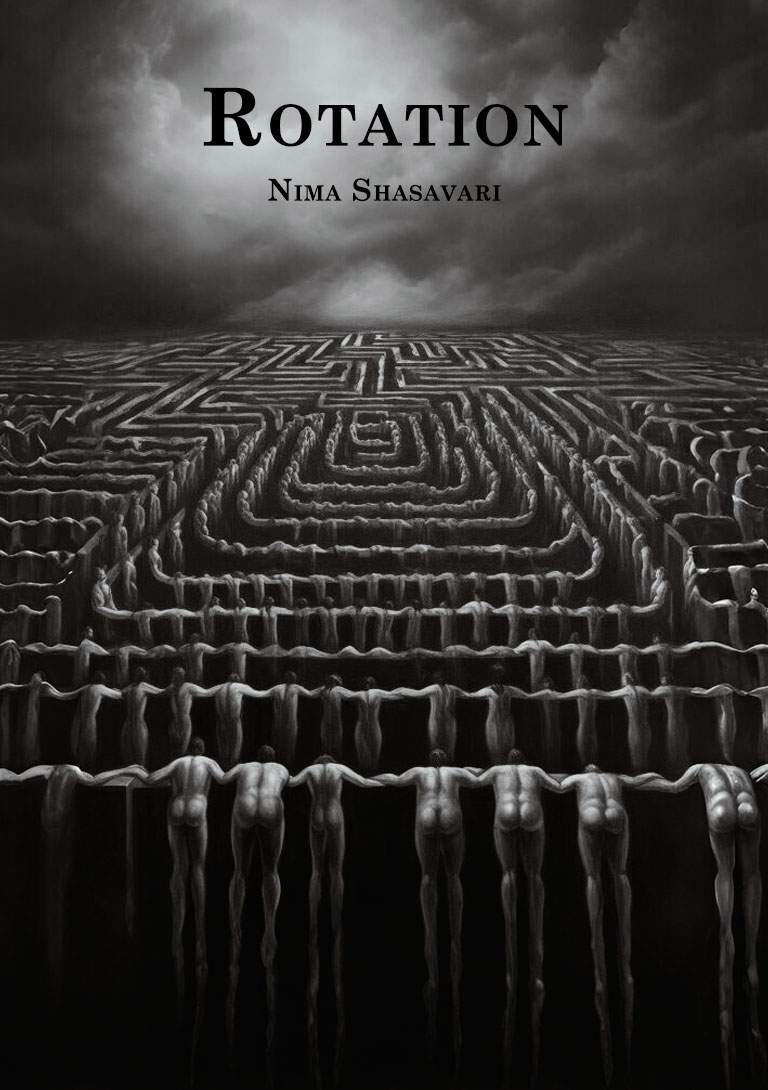


The Futile Wheel of Authoritarian Succession
In Rotation, Nima Shahsavari executes a clinical dissection of political revolutions, challenging the long-held belief that changing rulers equates to achieving freedom. The collection explores how historical movements repeatedly fall into the trap of substituting one elite class for another, leaving the underlying architecture of state oppression fully operational. When a populace seeks new saviors rather than dismantling the concept of sovereign authority, the cycle of exploitation merely renovates its methods while maintaining its grip on society.
This endless rotation of tyrants is rooted in a fundamental refusal to question the concentration of power itself. Shahsavari argues that as long as society accepts the premise that a singular brain or governing body has the right to rule over others, genuine liberation remains impossible. Dismantling tyranny requires cutting at the roots of power—refusing to bow before any authority that claims dominion over life and agency.
Media Hegemony and the Architecture of Soft Tyranny
A central pillar of the critique within Rotation is the genealogy of power in the digital and media age. The text illustrates how the raw, overt violence of historical autocrats has evolved into subtle, pervasive mechanisms of psychological control embedded in modern technology.
- The Spectacle of Compliance: How broadcast media and digital platforms distract populations, converting systemic injustice into popular entertainment.
- The Dissolution of Individual Conscience: The process through which manufactured consumer desires erode critical thinking and normalize mass passive obedience.
- The Illusion of Democratic Choice: Exposing how corporate wealth and media wizardry manipulate public opinion to solidify the rule of financial elites under the guise of choice.
Through these sharp narrative observations, the author reveals that modern subjugation is maintained not merely by physical force, but by capturing the imagination and conditioning the daily habits of the populace.
Displacement, Alienation, and the Myth of Sanctuary
The narrative scope of Rotation extends beyond national boundaries to interrogate the global structures of inequality and exile. In exploring the lived realities of displacement, the text shatters the myth of Western democracies as ultimate sanctuaries of human rights. Exiled individuals often find that crossing physical borders merely exchanges one form of captivity for another, reducing their existence to bureaucratic categories, legal non-citizenship, and economic exploitation.
Shahsavari exposes how global hierarchies label the dispossessed while insulating the privileged. True liberation cannot be found by escaping to a different geographical territory, but by confronting and dismantling oppressive structures everywhere. The text emphasizes that freedom must be reclaimed locally and globally through united collective awareness and resistance against all forms of institutional degradation.
Janism and the Transition to Radical Equality
The ultimate philosophical resolution of Rotation is anchored in Janism, an uncompromising framework of universal non-harm and species equality. The text insists that human political emancipation is fundamentally incomplete if it remains trapped within anthropocentric assumptions. As long as humanity licenses the plunder of nature and the subjugation of non-human beings, the logic of tyranny will continue to infect human institutions.
To embody these ethical principles, the distribution of the work deliberately bypasses traditional physical printing processes that require deforestation and natural plunder. Distributed as an open-access digital text, the publication of the book itself mirrors its message: knowledge must serve as a free, uncommodified common good that advances human consciousness without inflicting harm on the living planet.
Stepping Off the Wheel of Historical Repetition
The final trajectory of Rotation presents an urgent call to break the historical cycle of tyranny, servitude, and systemic violence. By holding a mirror to the ways in which individuals inadvertently participate in maintaining the status quo, Shahsavari compels readers to examine their own habits of submission and consumption.
Ultimately, Rotation serves as a definitive literary manifesto for an era seeking authentic structural change. By rejecting the worship of power, unmasking media manipulation, and grounding existence in radical equality and reverence for all breath, the work offers an indispensable path toward true, lasting emancipation.


