


Deconstructing Human Exceptionalism and Systemic Violence
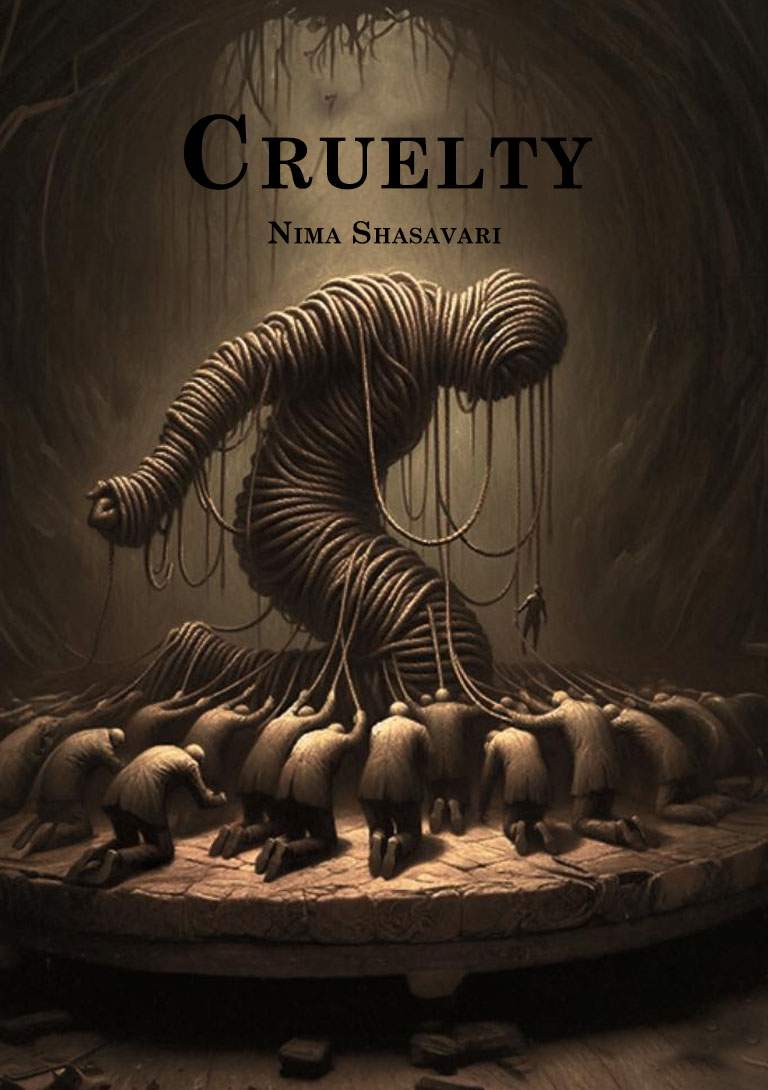
In Cruelty, Nima Shahsavari delivers an uncompromising philosophical critique of the long-standing conceit of human exceptionalism. For centuries, cultural, political, and theological systems have conditioned humanity to regard itself as the supreme creation, inherently entitled to dominate the earth and its inhabitants. This collection of 20 short stories systematically dismantles that premise, revealing that human civilization has institutionalized forms of violence and commodified suffering that have no parallel in the wild.
While non-human animals kill strictly within the limits of biological survival, human structures have transformed the infliction of harm into entertainment, commercial profit, and political dominance. Shahsavari argues that the rhetoric of civilization often serves merely as a sophisticated cover for organized exploitation. By exposing the reality of institutionalized harm, the text forces a fundamental re-examination of our moral standing and societal foundations.
The Mechanics of Life-Devouring and Structural Exploitation
A core theoretical development within Cruelty is the concept of life-devouring (Jan-khwari). The work expands the critique of exploitation beyond physical consumption to encompass the systematic extraction of life force, time, and agency from sentient entities.
- Commodified Vitality: How economic and social systems convert human labor, time, and health into abstract monetary instruments.
- Speciesist Domination: The normalization of non-human exploitation, treating sentient life as mere inventory or resources for human utility.
- Patriarchal and Domestic Control: The ways in which notions of ownership within the family structure rationalize psychological and physical trauma.
Through these interconnected narrative threads, the author demonstrates that the pyramid of power is sustained entirely by consuming the vitality of the weak, reproducing hierarchy across every tier of human interaction.
Anatomy of Abuse: From Private Trauma to Public Spectacle
The stories within Cruelty trace the trajectory of abuse from the micro-level of individual psychology to the macro-level of state governance. The text illustrates how childhood traumas, domestic ownership, and enforced silence inside the home mirror the mechanisms of authoritarian control operating in the public sphere. When society conditions individuals to accept authority and domination at home, it prepares them for passive integration into oppressive political structures.
Shahsavari also interrogates spectacle democracies and theatrical leadership. Rulers who position themselves as benevolent stewards are shown to view populations not as equal beings with intrinsic dignity, but as passive material to be molded and displayed. True resistance requires recognizing that public political charades and private domestic oppression stem from the exact same pathology of domination.
Janism and the Imperative of Biological Equality
In contrast to the pervasive darkness of systemic violence, Cruelty posits the ethics of Janism as the only path to authentic moral renewal. The text asserts that global peace cannot be engineered through treaties or political reforms while the foundational violence of our daily lives—specifically the slaughter and exploitation of living beings—remains unaddressed. Emancipation begins at the level of individual choice, starting with the refusal to participate in the consumption and harm of other lives.
Ethical Dissemination and Ecological Integrity
In strict alignment with its core message, Cruelty rejects physical paper printing and commercial publishing channels. Identifying the harvesting of trees as an act of ecological plunder, the author ensures that the dissemination of these ideas does not exact a toll from the natural world. Distributed exclusively as an open-access digital edition, the book functions as an active ethical intervention against resource extraction.
Reclaiming Conscience and Transcending Dominion
The ultimate vision of Cruelty is a call for humanity to step down from its self-appointed throne of dominion and return to a state of harmonious integration with nature. By replacing human exceptionalism with an active stewardship of life (Jan-yari), individuals can break free from the destructive cycles of historical violence.
Nima Shahsavari’s work serves as a vital literary manifesto for our era. By rejecting the commodification of suffering, dismantling domestic and political hierarchies, and upholding the sacred equality of all living breath, Cruelty provides an indispensable guide for building a compassionate and truly free world.


