
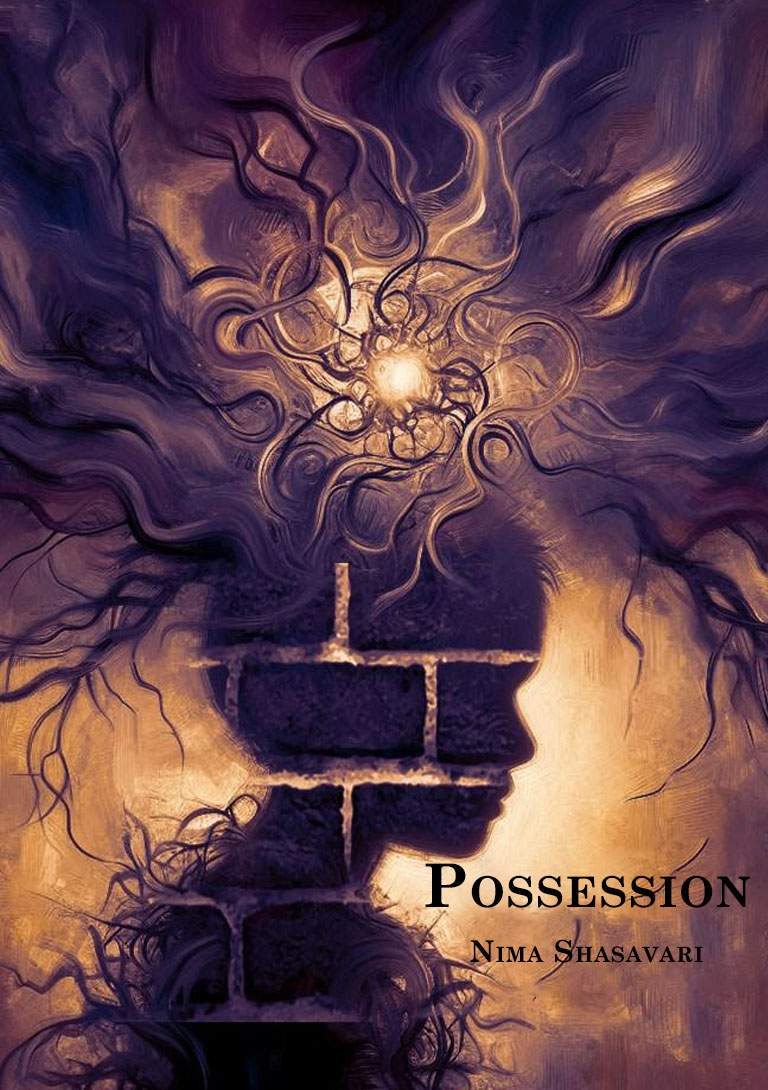


The Genealogy of Sacred Violence and Absolute Certainty
In Possession, Nima Shahsavari executes a clinical dissection of totalizing ideologies, revealing that the most destructive forms of tyranny do not arise from overt wickedness, but from an unshakeable conviction in one’s own supreme virtue. When a political or religious caste assumes the mantle of absolute truth, it inevitably constructs a legal and moral framework where dissenting voices are no longer viewed as political opponents, but as existential pollutants. Under this paradigm, institutional violence—ranging from psychological coercion to execution—is recast as a sacred duty to cleanse the body politic.
The novel investigates the terrifying psychology of those who execute state violence. Through systematic conditioning and dogmatic education, the state strips individuals of their personal identity, transforming them into anonymous agents of coercive power. These agents do not perceive their acts as criminal; rather, they view the infliction of suffering as a legitimate, sanctified procedure necessary to maintain cosmic and social order.
The Micro-Architecture of Tyranny Within the Domestic Sphere
A central insight of Possession is its exploration of how macro-level political oppression is continuously reproduced within the home. The text demonstrates that totalitarian apparatuses depend heavily on conservative family structures to internalize obedience before individuals ever encounter state institutions.
- Inherited Subjugation: How victims of historical oppression frequently transform into the fiercest enforcers of oppressive traditions within the household.
- The Erasure of Autonomy: The systematic suppression of individual inquiry in favor of collective compliance to ancestral or religious dogmas.
- The Family as State Model: The structural parallel between patriarchal domestic authority and authoritarian state governance.
Through these analytical layers, Shahsavari establishes that dismantling state tyranny is impossible without simultaneously confronting and breaking the authoritarian patterns embedded in domestic life.
Liberating Doubt Versus Dogmatic Blindness
In direct opposition to the apparatus of state possession, the narrative champions the transformative force of philosophical doubt. While dogmatic certainty demands total submission and freezes intellectual growth, critical inquiry opens pathways toward genuine self-determination and moral clarity. Even under conditions of severe physical captivity, an awakened mind capable of questioning unearned authority poses an existential threat to oppressive systems.
Janism and the Absolute Sanctity of Life
Beyond its critique of political and religious control, Possession grounds its vision of emancipation in the foundational philosophy of Janism. The work asserts that true liberation requires expanding our moral framework beyond speciesist and anthropocentric boundaries. Justice cannot exist in a society that licenses the exploitation of nature or the destruction of non-human life for abstract human ends.
In strict alignment with these principles, the book refuses physical paper printing. Identifying traditional publication as an unnecessary act of deforestation and ecological plunder, the author publishes the work exclusively as an open-access digital edition. Knowledge is treated as a universal common that must circulate freely without exacting a toll from the natural world.
Transcending the Trap of Ideological Subjugation
The ultimate trajectory of Possession serves as an urgent manifesto for an era plagued by ideological polarization and dogmatic fervor. By unmasking the mechanisms that transform moral certainty into state violence, Nima Shahsavari compels readers to examine their own complicity in structures of domination.
Ultimately, Possession demonstrates that true emancipation is found neither in acquiring political power nor in seeking new dogmatic saviors. Freedom emerges when humanity steps away from totalizing ideologies, embraces the humility of critical thought, and commits to an uncompromising ethics of non-harm and universal equality for all living breath.


