
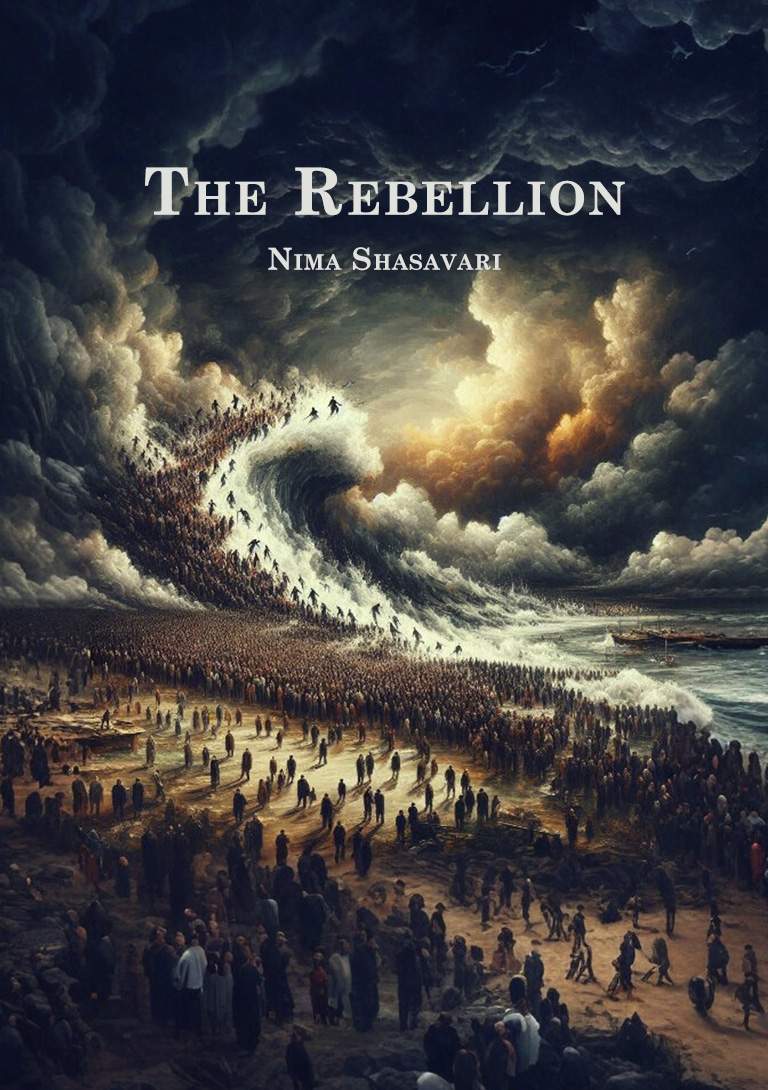


The Poetics of Defiance: Will Against Inherited Servitude
To engage with The Rebellion is to step into an intellectual furnace where every comforting myth of human salvation is melted down and recast. Nima Shahsavari’s poetic collection is not merely an aesthetic exercise; it is an uncompromising philosophical manifesto designed to awaken consciousness from its dogmatic slumber. Across these pages, the central premise is uncompromising: freedom is never a gift bestowed by benevolent authorities, nor is it a grace delivered by external saviors. It is an act of fierce, conscious creation wrested from the jaws of tradition.
The collection confronts the structural entrapment of human existence, tracing how societies perpetuate systems of exploitation through generations. From the moment consciousness is intercepted by institutionalized rituals of indoctrination—such as the arbitrary imposition of religious duties upon the young—the individual is molded into an instrument of obedience. Shahsavari’s poetry serves as an intellectual scalpel, excising these layers of artificial conditioning to reveal the raw, unyielding power of individual will.
Dismantling the Cruelty Machine and Wealth Idolatry
A cornerstone of the work is the conceptual dismantling of modern power dynamics through original archetypes. Shahsavari introduces the cruelty machine as a stark metaphor for the combined apparatus of religious dogmatism and political authoritarianism, which systematically processes human lives into fuel for domination. Alongside this stands the critique of wealth worship, where material power replaces sacred authority, reducing living beings to mere currency and disposable labor.
Furthermore, the text exposes the linguistic and moral double standards embedded in institutional histories, laying bare the hypocrisies used to mask systemic violence under the banner of divine will. By challenging these ancient narratives, the poems act as a sacred catalyst for doubt, encouraging readers to question every structure that demands the surrender of their critical faculties and moral autonomy.
Janism and the Overthrow of Anthropocentric Hubris
Moving beyond political critique, The Rebellion culminates in the ethical paradigm of Janism—a worldview that dismantles the foundational arrogance of humanism. For millennia, human civilization has defined itself through self-congratulatory supremacy, treating the natural world, other species, and vulnerable populations as expendable resources. Shahsavari rejects this predatory paradigm entirely.
- Radical Equality: Recognizing the intrinsic value of every living consciousness, independent of utility or cognitive status.
- Plant-Based Justice: Aligning daily existence with non-harm, making dietary ethics a fundamental component of universal justice.
- The End of Dominion: Replacing the divine right of exploitation with an ethos of protective stewardship and universal kinship.
Within this framework, any civilization that builds its progress on the suffering of others is recognized as fundamentally bankrupt. The true prophet of freedom is not one who brings laws from the sky, but one who plants the seed of sacred doubt within the hearts of the enslaved.
The Digital Imperative: Freedom Without Exploitation
True to its philosophical foundations, the release of The Rebellion mirrors its message of non-harm. Recognizing that traditional publishing often exacts a heavy toll on the natural world, Shahsavari rejects the physical commodification of books as an act of violence against nature. By choosing open-access digital distribution, the work ensures that the message of liberation does not require the sacrifice of living trees.
Ultimately, The Rebellion challenges every reader to abandon the waiting game of miracles. It is an urgent, poetic summons to embrace the responsibility of freedom, break the chains of inherited oppression, and build a world where love and non-harm govern every living breath.


