
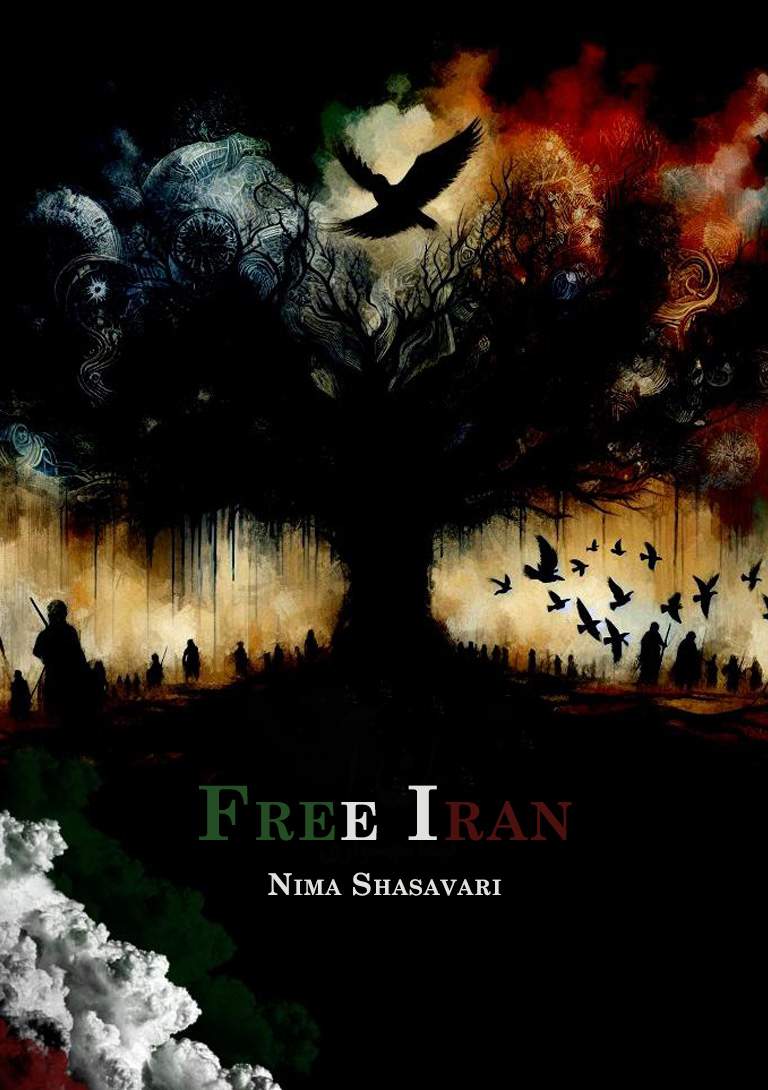


Beyond Borders: Redefining the Homeland of Consciousness
To read Free Iran is to witness the deconstruction of traditional nationalism and the birth of a universal ethical geography. Nima Shahsavari crafts an epic poetic critique that challenges the very foundations of how societies define belonging, loyalty, and territory. In this sweeping philosophical work, the concept of the homeland is liberated from the grip of geopolitical maps and nationalistic mythologies, emerging instead as the universal domain where life, dignity, and awareness are protected.
Nationalism has historically functioned as a mechanism to herd populations into competing camps, justifying endless conflict in the name of abstract borders. Shahsavari cuts through this illusion by proposing that true kinship is spiritual and ethical, uniting those who fight against tyranny and uphold the sanctity of existence. By dismantling arbitrary divisions, the epic invites readers to view themselves not as subjects of a specific flag, but as citizens of an interconnected, living earth.
The Twin Faces of Tyranny: Unmasking the Cycle of Power
A central pillar of the epic’s historical analysis is its ruthless exposure of the rotating machinery of oppression. Across generations, societies fall into the trap of believing that replacing one master with another equates to liberation. Shahsavari uses evocative imagery to demonstrate how absolute power merely changes its costume—transitioning from secular throne to religious pulpit—while maintaining the same fundamental structures of dogmatic control and subjugation.
The text traces the historical descent of institutionalized violence, examining how the imposition of dogmatic ideologies crushed ancient intellectual splendors and reduced populations to compliant followers. By confronting dark chapters of state-sanctioned cruelty, the poetry ensures that collective memory remains an active shield against future tyrannies, demanding that the human mind break free from the hypnosis of divine right and autocratic rule.
Janism and the Ecological Foundations of Freedom
What distinguishes Free Iran from conventional political poetry is its ultimate grounding in the philosophy of Janism. Shahsavari argues that political freedom is an empty illusion if it is accompanied by biological exploitation. True justice must be comprehensive, extending moral consideration beyond human borders to embrace all living beings.
- Dietary Justice: Recognizing that peace begins at the dining table, with plant-based living as the first step toward universal non-harm.
- Rejection of Anthropocentrism: Dethroning the human species from its imagined pedestal of supremacy over nature.
- Total Demilitarization: Envisioning a future devoid of weapons, where survival does not depend on the subjugation of the weak.
In this framework, any civilization that builds its progress on the suffering of animals or the devastation of ecosystems is fundamentally illegitimate. Liberation requires abandoning the worship of power in all its forms and returning to an absolute reverence for life.
The Digital Sacredness of the Word
Reflecting its unwavering commitment to ecological preservation, Free Iran rejects the traditional physical publishing model. Shahsavari views the destruction of forests for paper as an act of violence against nature, making the digital, open-access distribution of this epic a moral necessity. The message of liberty must never demand the sacrifice of living trees.
Ultimately, Free Iran serves as an enduring manifesto for the human spirit. It teaches that freedom cannot be granted from above; it must be lived, practiced, and defended through an uncompromising awakening of consciousness, empathy, and absolute respect for all existence.


