
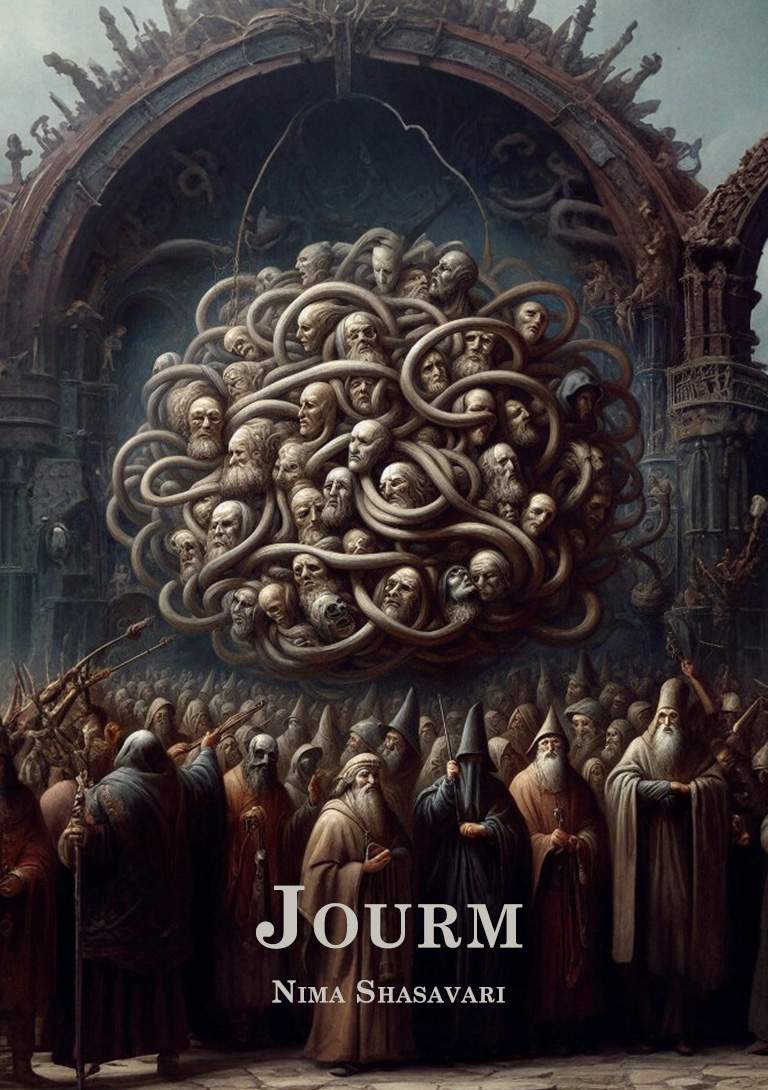


Dismantling the Sanctity of Dominance: A Poetic Interrogation
To engage with Jourm is to enter a rigorous philosophical courtroom where the foundational premises of religious authority and dogmatic morality are placed on trial. Nima Shahsavari crafts a powerful collection of philosophical poetry that systematically dismantles the venerated status of sacred institutions. Across these poems, the text argues that throughout human history, sacred terminology and divine sanctions have frequently functioned as refined instruments of coercion, converting autonomous beings into compliant subjects of centralized power.
The work deconstructs the psychological mechanisms of inherited servitude. Shahsavari examines how societal structures apply ideological labels to individuals at birth, predetermining their existential trajectory before critical reason can awaken. This systemic imposition of belief is identified as a primary source of human alienation, severing the connection between conscious life and the natural ethics of non-harm. By exposing these dynamics, Jourm urges a complete purging of external dogmas to restore the pristine integrity of the individual conscience.
Compulsory Morality and the Deconstruction of Sacred Myths
A major focus within Jourm is its ruthless critique of forced compliance in both thought and physical expression. Shahsavari establishes a direct link between mandatory religious codes and the historical suppression of human wisdom. The poems argue that enforced modesty and coerced beliefs are twin manifestations of an authority that fears the uninhibited exercise of human reason.
Furthermore, the text offers a subversive re-examination of traditional theological rewards and punishments. Conceptions of paradise that promise endless gratification are critiqued as mundane projections of human greed and existential boredom. Shahsavari contrasts the artificiality of these dogmatic promises with the unpretentious dignity of the natural world, illustrating how non-human animals often embody a purer, more authentic adherence to non-harm than human institutions claiming divine mandate.
Janism and the Universal Imperative of Non-Harm
The philosophical climax of Jourm rests upon the radical paradigm of Janism. Shahsavari asserts that any philosophy, religion, or political ideology that sanctions the harm, exploitation, or slaughter of living beings—whether human, animal, or plant—is fundamentally bankrupt. Liberation cannot be achieved through the subjugation of others; it exists only where non-harm is elevated to an absolute law.
- Eradication of Hierarchies: Overthrowing the anthropocentric illusion that places human ambition above the sanctity of other conscious life.
- Authentic Moral Agency: Locating virtue not in submissive obedience to ancient canons, but in active, conscious empathy toward all living beings.
- The Republic of Consciousness: Envisioning a borderless existence where every living entity functions as its own sacred temple, free from institutional domination.
Through these poetic declarations, Shahsavari redefines the ultimate crime (Jourm) not as the violation of arbitrary religious taboos, but as silence and acquiescence in the face of systemic cruelty and the deprivation of liberty.
Digital Sacredness: The Ethics of Open-Access Distribution
In complete alignment with its core message of universal non-harm, Jourm strictly eschews traditional paper publishing. Shahsavari contends that printing a manifesto of liberation upon the felled bodies of living trees constitutes a profound moral contradiction. To harvest nature for the sake of preaching non-violence is an ethical failure that the text refuses to commit.
By making the entire work freely accessible through open-access digital platforms, Shahsavari ensures that the call for intellectual awakening reaches humanity without inflicting harm upon the ecosystem. Ultimately, Jourm stands as a vital beacon for modern critical thought, guiding conscious minds away from the dark corridors of dogmatic authority and toward the luminous horizon of universal reverence for life.


