The Paradox of Elixir Survival and the Genealogy of Erosion in the Delirium of Devouring
Wounded Consciousness in the Frozen Corridors of the Factory and the Rigid Existential Dead End
When wounded, radical, and rebellious consciousness sits within the frozen, viscous, and suffocating corridors of the factory of human engineering and mass-production of generations, observing the bloody and dark boundaries of its own self-destruction, it confronts the first, most terrifying, and most paralyzing rigid existential and material dead end: a blind, corrupt, and structural knot that completely shatters and dissolves the meaning of living and breathing in the slaughterhouse of the lords’ civilization. At this point of cognitive rupture, the subject realizes that its daily life is not a natural flow, but a engineered process of material extraction.
The formidable and aggressive question that descends upon the body of this contracted consciousness tears the veil of civilizational modesty: Is the toxic, material elixir that you apply every day to your face and skin—to cure structural decay, physiological decline, aging, and to delay the inevitable disintegration of the flesh—not crafted from the distillation, fragmentation, butchery, and suction of the final organic and cellular screams of a rebellious and independent soul? The very soul that fought for your existential freedom and the rejection of abusive structures, only to be lost, melted, and recycled within the hidden, dark, and concrete corridors of Radah?
The Continuous Erosive Delirium and the Conversion of the Outcasts’ Suffering into the Nutrients of the Elite
This confrontation is a continuous, systematic, and erosive delirium—a dirty, naked, and unvarnished encounter with the material reality that the lords’ extraction and exploitation system transforms the suffering, blood, and vital potential of other outcasts and the pariahs of the common plain into nutrients, genetic copies, and youth worms for the elite and terrified slaves. To perpetuate their own mechanical survival, these subjugated organisms ruminate on their gradual death, cellular contraction, and decay in the absolute physiological isolation of warehouse cells.
The Denial of the Value of Breathing and the Transformation of the Life-Artery into the Machine’s Mechanical Arm
This philosophical and material dead end completely denies the lofty value of free breathing and binds the body to the industrial warehousing of meat. A body that yields to false immortality and survival tokens by devouring the essence of the rebels’ existence becomes so detached and alienated from the harmonic, regular breath of the soma that its carcass is reduced to a contracted, stiff, and impermeable flesh-armor. This intense contraction reduces the organism’s movement rhythm to nervous tics born from the terror of dissolution, causing the life-artery—before it can grasp horizontal connection—to dissolve in the biological swamp of civil laws and transform into the mechanical arm of the system of domination.
The Paradox of Terrified Survival and the Dissolution of the Organism in the Sludge of Gear-Like Obedience
The Hall of Shattered Mirrors and the Terror of Identity Collapse in Subjugated Organisms
The second striking, rigid, and paralyzing question confronts wounded consciousness within the hall of its shattered, dusty, and dark mirrors with the terror of appropriation, transmutation, and definitive identity collapse. This phenomenological challenge directly targets the biological foundations of the subject: If the entire meaning, purpose, function, and logistics of your life are summarized in the constructed, imposed, and decorative concept of survival, and if this mechanical, base, and biological survival is possible only through rigid obedience, taqiyya (dissimulation), silence, and submission before the executioners of the Ministry of Filth, are you truly alive? Does your carcass possess any share of the essence of being?
Material reality exposes that you are merely a putrid, transfigured, and ruined corpse that—by the permission, will, and tokens granted by the masters of power and the lords—has been granted permission to wriggle, mechanically breathe, and roll about in the swamp of polluted civilization. This predatory, filthy, and apartheid-like segregation regards social stability and factory discipline not as the product of organic consent or genuine solidarity among bodies, but as the direct, engineered, and definitive achievement of the fear injected day and night into the veins and nerves of the masses by operators.
The Completion of the Fuel Production Chain and the Official Language of Legal Subjugation
This naked, material, and instinctive submission activates the sensory fabric of biological disgust and repulsion within the cellular layers of the text. When the organism accepts imposed identity barcodes and commands to leap in order to temporarily preserve its worn-out carcass, it completes the chain of fuel production and meat warehousing for the power system. Law, in this inverted geometry, is nothing other than the official language of this subjugation and mass burial. The false gardeners and slaughterers of the lords’ plain constrict the breathers’ young bodies with disciplinary codes.
The Castration of Radical Upheaval and the Eternity of the Genetic Memory of Violence in the Muscles
The purpose of this contraction is the castration, suppression, and freezing of any radical upheaval and existential revolt prior to its occurrence. A body that wriggles in this filthy swamp and sanctifies its chains is—before reaching the final slaughterhouse and boiling cauldrons—fragmented in the daily process of logistics and transport, permanently eternalizing and institutionalizing the genetic memory of violence, intimidation, and erosion in its muscles, nerves, and fibers, thereby severing its bond with pure nature.
The Paradox of Self-Willed Burial and Sequential Fall in the Tiers of the Slaughterhouse
The Frozen Breath of the Fall and the Deconstruction of the Mechanism of Humiliating Survival
The deepest, most terrifying, and most ruthless existential and material challenge throughout this aggressive manifesto manifests in an ominous and frozen moment when you witness the burial, fragmentation, and slaughter of a rebellious and independent insurgent, and—to preserve your false bureaucratic security and maintain your worn-out organism—you cast a handful of dirt upon their grave. This instinctive and terrified action drops the echo of a formidable question upon the body of the transfigured subject: Do you realize, in that frozen and suffocating breath, that with every handful of dirt you hurl, you are in fact eagerly—driven by terror—filling your own grave on the upper floor of this vertical structure and inverted geometry?
This question deals a rigid, heavy, and devastating blow to the civilizational idols of progress, technological development, and all the civil compacts of the factory, shattering the illusion of security. For years, the lords’ system—by pumping the ideology of submission—mobilized breathers to destroy the bond of life, so that the masses, to preserve their partial and temporary survival, would cast dirt upon the mouths of the free, unaware that the looted, extracted, and eroded soil has already saturated its cellular memory with the blood of the virgin and the trauma of repression, and utterly loathes devouring subjugated carcasses.
The Absolute Physiological Isolation of the Suspended Subject in the Absence of Sanctuaries of Well-being
This terrified and obedient action leaves the subject completely alone, abandoned, and suspended in its final, definitive, and unbridgeable dead end. A system built entirely upon devouring weak souls, sucking life-arteries, and biological plunder leaves no sanctuary for well-being, compassion, or existential freedom. Throwing dirt upon the insurgent’s body is the official signing of one’s own warrant of destruction; for once the pulses of rebellion cease and the frequency of revolt is silenced, the machine will open its massive hydraulic mouth to devour and fragment the next tier.
The Reduction of the Surrendered Organism to Biological Fertilizer in the Depths of the Well of Oblivion
This rigidity of the system’s will and the machine’s explicit material extraction reduces the surrendered and trembling organism to a biological fertilizer and mechanical residue buried at the bottom of the well of oblivion under the supervision of warehouse guards. Meanwhile, the lofty layer of the earth and the cellular memory of the soil abhor accepting his subjugated, poisoned, and barcoded body, slamming the door in the face of this ruined copy so that the organism remains suspended in absolute nothingness amid the void of this rejection.
Decay as the Continuous Act of Physiological Attrition on the Metal Floor
Phenomenology of Flesh Ripping and Skin Shedding in Logistic Carriers
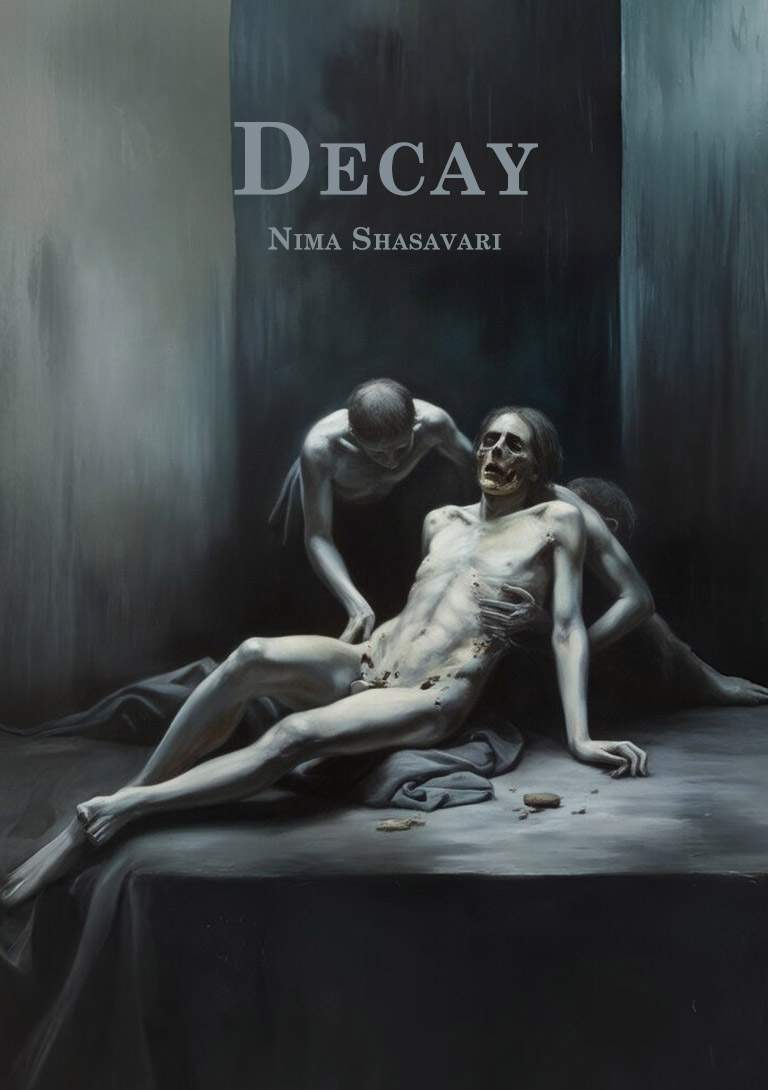
The sensory, linguistic, and phenomenological fabric of this aggressive, naked, and ruthless manifesto is entirely and structurally under the absolute dominion of the word decay—a key term repeated across all layers of the text not as a neutral, abstract, or reporting adjective, but as a continuous, biological, active, and repulsive action. Decay in this realm is the phenomenology of torn-away chunks of flesh, eroding muscles, and the continuous shedding of dead skin upon the metal, rusted, and bloody floors of buses, warehouse wagons, and the lords’ system logistic carriers.
This imagery is a naked, filthy, and shocking symbol of organic and physiological decline in which the bodies of outcasts and the pariahs of the common plain, prior to reaching the final slaughterhouse, are fragmented, consumed, and shattered under the rigid, mechanical, and suffocating pressure of the crowd, ensuring that the frozen threads of biological apartheid and the structure of power maintain their firmness and persistence. This subcutaneous and continuous attrition renders the corrupt, viscous, and sedimented layers of ideology fully visible, tangible, and naked upon bodies.
The Factory Carcass’s Incapacity to Preserve Soma and Confronting the Putrefaction of Rigid Theocracy
Continuous cellular decay is material and objective proof that the factory carcass and subjugated body can no longer sustain the harmonic, regular breath of the soma and the bond of life. In this atmosphere of constriction, suffocation, and heaviness, the organism perceives the use-value of its body in the shattered mirror and physiological putrefaction of generational relations and rigid theocracy. This sensory fabric bypasses any geographical illusion regarding civil security, technological welfare, and contractual rights, abandoning the body in a biological sludge from which no thief can find escape.
Phenomenology of Wriggling in the Pool of Putrefaction and the Dissolution of Body Boundaries
The Transmutation of Bodies into Dense Flesh in Endless Corridors
The objective, material, and physiological manifestation of the organic rupture between authentic life and constructed civil individuation is embodied in the biting, corrupt, and terrifying image of wriggling. Wriggling in this poisoned structure is the base, inevitable, instinctive, and circular movement of the masses amid mud, excrement, viscous secretions, and the halls of filth belonging to the lords’ civilization—a filthy image of infected worms in poisoned, fragmented soil, where the material and biological boundary between their contracted bodies has completely vanished, reducing them to a dense, subjugated, mindless mass devoid of the impulse of revolt. This continuous, cyclical, and meaningless movement consists of the nervous tics and disciplinary codes pumped by the system to preserve factory stability.
Within the sensory fabric of this inevitable wriggling, all individual distinctions, organic boundaries, and existential awareness are entirely dissolved, reducing radical consciousness to a neutral, reactive, and harmless secretion within the void of wells and hidden corridors. Instead of forming a horizontal bond of souls, establishing a cooperative colony, and restoring the free temple of the body, organisms in this contracted state climb over one another in worm-like solidarity to preserve survival tokens and mechanically ascend to the masters’ plain, reducing the cries, pain, and execution of living beings under the blade to background and auxiliary noise.
The Phenomenology of Futile Suffering at the Cost of the Complete Stripping of Existential Freedom
This inevitable wriggling renders the phenomenology of futile suffering and biological extraction fully visible and tangible within the endless, dark corridors of the Ministry of Filth—an inverted geography where the transfigured body accepts the false, bureaucratic, and mechanical security of the slaughterhouse at the cost of the complete stripping of existential freedom, the fragmentation of instincts, and the severing of connection with pure nature. Relying on this worm-like movement, the system harnesses organisms on the vertical scale of power, preventing the formation of radical impulses and frequencies of revolt across the expanse of existence.
The Rigid Logic of Silence and the Suspension of Resonance in the Corridors of the Factory of Devouring
The Freezing of the Text’s Atmosphere in Absolute Suffocation and the Guard’s Seal of Silence
At the culmination of this aggressive, naked, and ruthless inquiry, the key term silence—acting as the ultimate, definitive, and material manifestation of structured decline—freezes the text’s atmosphere and life-artery in absolute, rigid, and unbridgeable suffocation. Silence in this poisoned and inverted realm does not signify mystical quietude, wisdom-seeking, biological peace, or inner harmony with the essence of being; rather, it signifies the suffocating, pitch-black, and rigid weight of the seal of silence that fear, intimidation, dread, and the impulses born from the terror of the inner observer stamp upon the lips of breathing organisms.
This silence is a frozen and structural resonance equivalent to physiological death and final dissolution, echoing through the dark, damp, concrete corridors of the factory of devouring, the lords’ command rooms, and Radah’s hidden corridors, crushing, contracting, and dissolving any cry of rebellion, frequency of revolt, and rebellious impulse in the bud. This rigid and suffocating suspension proves that within the framework of social contracts, factory bureaucracy, and the civil laws of the Ministry of Filth, language and word have completely broken down and lost their subversive value.
Absolute Physiological Loneliness in Nothingness and the Fall Beyond the Clichés of Power
This silence is the obedient, terrified, and corrupt quietude chosen by slaves for the temporary preservation of their mechanical survival—the very ones who cast dirt upon the mouth of the rebel and now, within the hall of their dusty mirrors, experience absolute physiological loneliness and the erosion of body layers. This frozen resonance paralyzes all natural earth impulses, forging a morrow devoid of organic and dynamic movement: a final, rigid, and unbridgeable dead end where the life-artery is locked in eternal contraction and the carcass completes its fall into the pure nothingness of the wasteland, far beyond the clichés of power.




Submitted thoughts are reviewed prior to publication to maintain alignment with these foundational principles. We encourage you to review the governing documents: